
The Self-Employed Tax Trap: Why Business Owners Get Caught Out (and How to Fix It)
You made the sale. The money is in your bank. So why doesn’t it feel like it’s yours?
There’s something nobody really teaches you when you become self-employed: the money coming into your business isn’t all yours. It sounds obvious, but it’s one of the biggest mindset shifts a new business owner has to make and failing to make it catches people out time and time again.
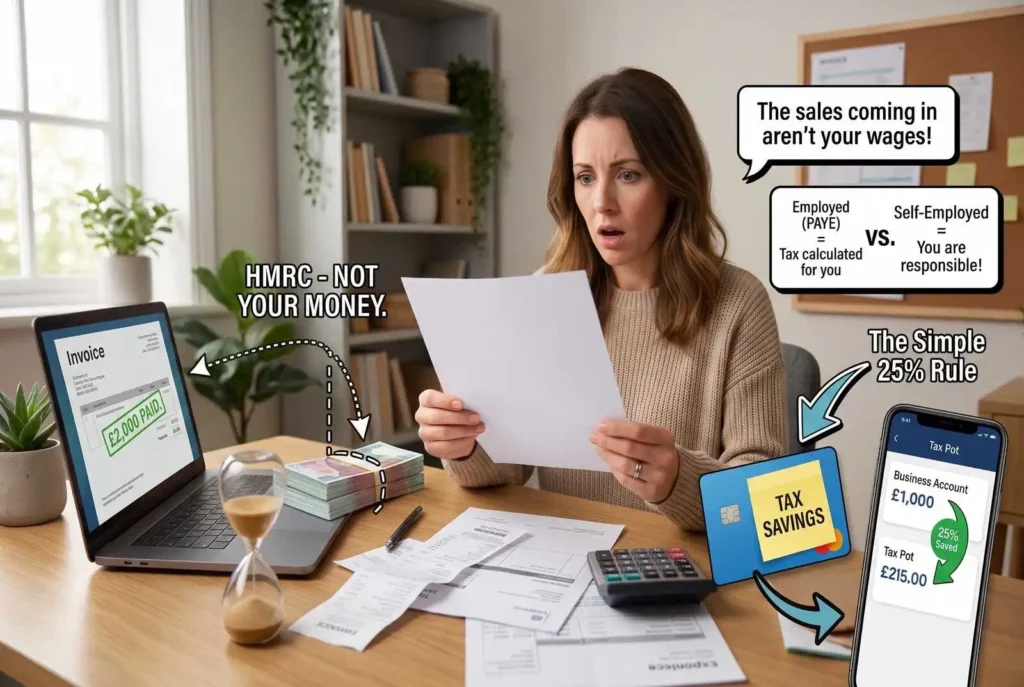
Employee vs. Self-Employed: The Tax Mindset Shift
When you’re employed, tax is easy. Perhaps “easy” isn’t the word you’d use when you look at your payslip and see how much tax and National Insurance has vanished, but the important thing is that you don’t have to think about it. Your employer calculates your tax, deducts it from your wages, and sends it directly to HMRC. What lands in your bank account is effectively your money to spend.
Then, you become self-employed. Suddenly, you receive a £2,000 payment from a customer, and it feels like you’ve got £2,000 to spend.
But you haven’t.
That £2,000 sitting in your bank account can be highly misleading. From that single payment, you have to account for:
- Overhead and business expenses
- VAT (if you are registered)
- HMRC's eventual share of your profits
The "Business Expense" Myth: How Tax Relief Actually Works
“But I’ve got loads of expenses…”
This is another common trap. Business owners often assume that because they’ve spent money on something for the business, they’ll get all of that money back through tax relief.
Unfortunately, that’s not how HMRC works. Tax relief doesn’t mean the government pays for your expenses. It simply means that qualifying expenses reduce the amount of profit you pay tax on. Spending £1,000 does not mean you’ve saved £1,000 in tax.
When cashflow is already tight, it can be incredibly tempting to dip into the money you’ve passively set aside for tax just to get through the month. Then the self-assessment bill arrives, and suddenly you’re thinking: “Where on earth am I going to find that money?”
Changing the Way You Think About Money
Moving from employee to business owner isn’t just about starting a business. It’s about fundamentally rewiring how you view income.
- When you're employed: You get paid.
- When you're self-employed: Your business gets paid.
Those are two very different things. The sales coming into your business are not your wages. They need to cover your operating costs, your tax liabilities, and ultimately, the money you choose to draw from the business. To build a successful, scalable company, you need to start treating tax as a standard monthly business expense, rather than a nasty, unexpected bill.
How to Avoid the Tax Trap: The 25% Rule
Moving from employee to business owner isn’t just about starting a business. It’s about fundamentally rewiring how you view income.
- Set up a separate savings account strictly for tax. Keep this separate from your day-to-day operational current account.
- Move at least 25% of every sale into that account immediately. Do this as soon as the money hits your business.
- Be proactive, not reactive. Don't wait until the end of the financial year. Don't wait until your accountant tells you what you owe, and definitely don't wait until the tax bill lands on your doormat.
Will 25% always be exactly what you need? No. Your actual tax position will fluctuate depending on your unique circumstances, total profits, other income streams, and your business structure. But as a baseline starting point, it makes a massive difference.
Here is the most crucial step of the 25% rule: Pretend that money doesn’t exist.
It is not your spending money. It is future tax money. When January rolls around and your tax bill arrives, you’ll be incredibly glad it’s sitting there waiting.
Implementing this simple change takes the panic out of tax, makes cashflow forecasting easier, and changes the way you look at the money in your business. Because being a business owner isn’t just about making sales it’s about knowing exactly what you can actually afford to keep.
Need advice?
Ready to step out of the daily grind? Contact us today to schedule a strategy call and let’s get your time back.
We are here to Help – Book a Chat Today.